

Benue Doctors Paid ₦158.66 as NARD Raises Alarm Over BSUTH Crisis
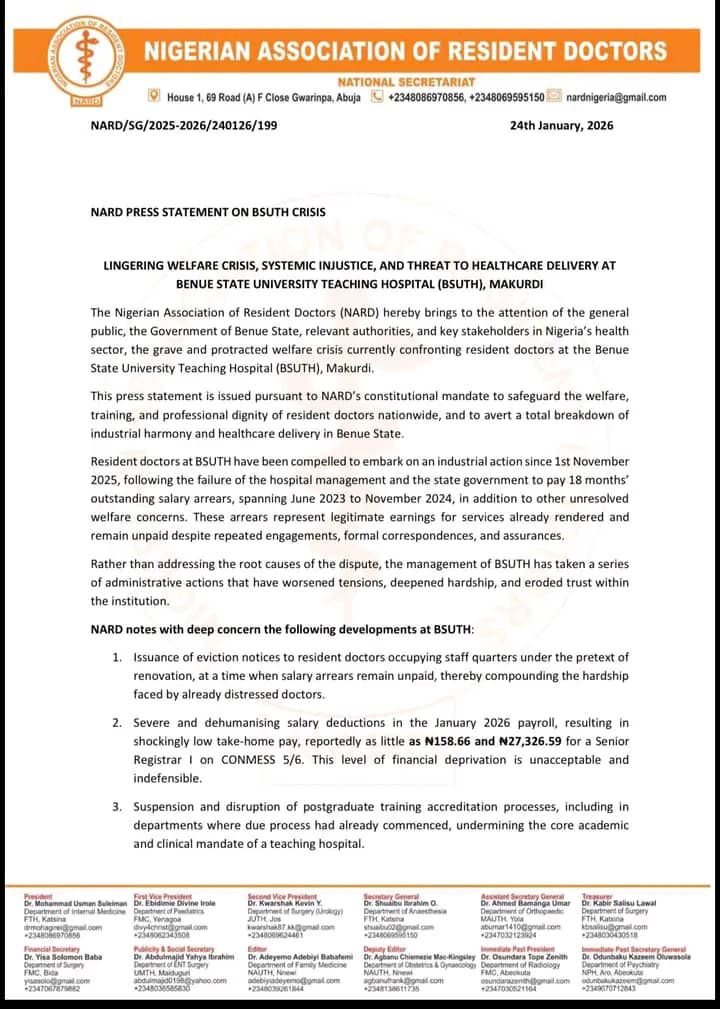
The Nigerian Association of Resident Doctors (NARD) has raised alarm over a deepening welfare and governance crisis at the Benue State University Teaching Hospital (BSUTH), Makurdi, warning that the situation threatens healthcare delivery, medical training, and industrial stability in Benue State.
In a press statement issued on 24 January 2026, NARD disclosed that resident doctors at BSUTH have been on industrial action since 1st November 2025, following the failure of the hospital management and the Benue State Government to pay 18 months’ salary arrears, spanning June 2023 to November 2024.
According to the Association, the unpaid salaries are “legitimate earnings for services already rendered” and remain outstanding despite repeated engagements, formal correspondences, and assurances from relevant authorities.
NARD accused the management of BSUTH of worsening the crisis through what it described as “administrative actions that have worsened tensions, deepened hardship, and eroded trust within the institution,” instead of addressing the core issues in dispute.
Among the actions highlighted is the issuance of eviction notices to resident doctors occupying staff quarters, which NARD said were served “under the pretext of renovation, at a time when salary arrears remain unpaid, thereby compounding the hardship faced by already distressed doctors.”
The Association also condemned severe salary deductions in the January 2026 payroll, revealing that some resident doctors were left with “shockingly low take-home pay, reported as little as ₦158.66 and ₦27,326.59.” NARD described the development as “unacceptable and indefensible.”
Beyond welfare concerns, NARD warned that the crisis is undermining BSUTH’s mandate as a teaching hospital. It cited the suspension and disruption of postgraduate training accreditation processes, noting that such actions “undermine the core academic and clinical mandate of a teaching hospital.”
The Association further raised concerns over threats to terminate or truncate residency training on allegations of overstaying, without due consideration for “systemic delays, manpower shortages, and prevailing national workforce challenges.”
Other grievances listed include the selective and arbitrary payment of allowances, the withholding of statutory and earned entitlements, and the issuance of an internal memo directing the recovery of allowances allegedly paid in error, “even though many of these allowances are statutory components of resident doctors’ remuneration.”
NARD also faulted threats by management to apply the “No Work, No Pay” principle while the labour dispute remains unresolved, warning that such a move would further strain “already fragile industrial relations.”
In response to the situation, NARD said its leadership has resolved to formally write to the Governor of Benue State, escalate the matter to the Nigerian Governors’ Forum (NGF), and caution the Chief Medical Director of BSUTH against further actions “capable of worsening the situation.”
The Association is demanding the immediate restoration of all deducted allowances, prompt settlement of the 18 months’ salary arrears, and a clear, verifiable commitment by BSUTH management to prioritize the welfare, remuneration, and retention of resident doctors. It also called for the immediate reversal of all actions aimed at terminating or truncating residency training.
NARD warned that failure to act could lead to escalation beyond the state level, including coordinated national protests, adding that while it remains open to dialogue, it will not waver in its obligation to protect its members.