
Written by Aondoakaa Tersugh Daniel
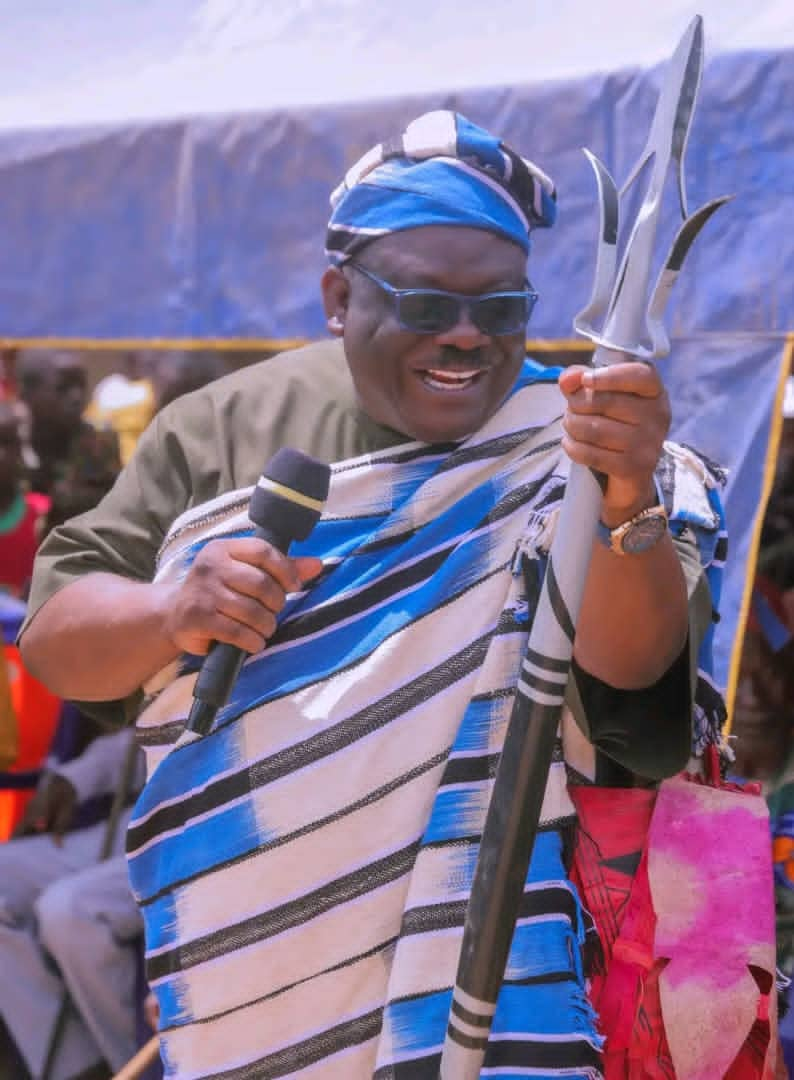
For a state whose children are being driven from classrooms by insecurity and whose families are being pushed from farms that once financed their education, rebuilding Benue’s education system cannot begin and end with the construction of classroom blocks. It must begin with something more fundamental: creating an environment in which a child can live, learn and dream without fear. This was the thinking behind Chief Michael Kaase Aondoakaa SAN’s education agenda as he interacted with the Benue community in Lagos last weekend.
Aondoakaa’s proposition is straightforward but profound. Security and education are not two separate items on the development agenda. They are interconnected. A child who is forced out of his ancestral home by violence does not merely lose a house. He may lose his school, books, friends, teachers, farm, family income and, in some cases, parents. UNICEF’s documentation from Benue illustrates this reality vividly. At Ortese IDP camp, more than 1,000 school-aged children had been displaced by insecurity, while in 2025 the Yelwata attack forcibly displaced more than 3,000 residents, including more than 500 children.
The scale of displacement is enormous. Amnesty International reported that 500,182 people had fled to IDP camps in Benue by 31 December 2024, with more than 10,000 additional people displaced in 2025. IOM subsequently put the state’s IDP population at 457,666 as of February 2025, identifying communal clashes, farmer-herder clashes and insurgency among the principal drivers of displacement. These are not merely statistics about humanitarian relief. They represent families whose livelihoods and children’s education have been violently interrupted.
The educational consequences are already visible. In September 2025, more than 200 children at the John Mark IDP camp in Daudu, Guma Local Government Area, had reportedly been out of school for several months because there was no school available for them. UNICEF’s 2026 account of children at Abegana IDP camp similarly describes children whose education had been interrupted for years by displacement and who were only beginning to return to learning after classrooms were rehabilitated.
This explains why Aondoakaa’s emphasis on security is important to his education proposition. The first classroom is the home, and the first condition for learning is safety. If communities remain deserted, farms remain inaccessible and children continue to live in displacement camps, government cannot sustainably solve the education crisis merely by renovating classrooms in urban centres. The ultimate objective must be to restore security sufficiently for displaced families to return to their ancestral communities, rebuild their livelihoods and send their children back to stable schools.
But returning a child home is only half of the equation. The other half is ensuring that the child can actually afford to remain in school. This is where Aondoakaa’s proposed scholarship intervention becomes significant. He has proposed an annual ₦2 billion scholarship and student-support scheme for indigent Benue students, with the stated objective of ensuring that qualified students do not abandon tertiary education because of financial difficulties.
There is a compelling social argument behind such a policy. Many Benue families traditionally depend on farming to finance their children’s education. When insecurity drives a farmer away from his land, the economic consequences do not stop at the farm gate. School fees become difficult to pay. Accommodation becomes a problem. Feeding becomes uncertain. A child who might otherwise have proceeded to university can suddenly become a dropout. Research on displaced Benue communities has documented precisely this experience, including displaced persons who reported abandoning their education because they could no longer afford to continue.
Aondoakaa’s proposal to support 20,000 tertiary students therefore deserves to be viewed beyond the immediate value of a scholarship cheque. Properly designed, it could become an instrument of social recovery for families whose economic foundations have been destroyed by conflict. It could particularly prioritise orphans, children from displaced households, students from communities affected by attacks and indigent students whose families have lost their farms or other sources of livelihood.
Perhaps the most personal dimension of Aondoakaa’s argument is his recollection that he himself benefited from scholarship as a student. That experience appears to have shaped his understanding of education not simply as government expenditure but as an investment capable of changing the trajectory of an individual and, ultimately, a society. The question before Benue, therefore, is not merely how many classrooms can be built. It is how many children can be rescued from the cycle of displacement, poverty, school dropout and lost opportunity.
Security must therefore come first, but education must immediately follow. A child cannot learn effectively while fleeing violence. A displaced family cannot sustainably educate its children without a livelihood. And an indigent student cannot remain in university simply because government has built a beautiful classroom somewhere else. Benue’s education crisis requires an integrated response: secure the communities, restore displaced families, rebuild schools, protect livelihoods and provide targeted scholarships for students whose circumstances have placed education beyond their reach.
That is the broader significance of Aondoakaa’s proposition. The objective should not merely be to put children inside classrooms; it should be to create the conditions that allow them to remain there, learn effectively and graduate. For a state that has lost so many years to insecurity and displacement, rebuilding education must mean rebuilding the entire ecosystem around the child.