

By Terver Akase PhD
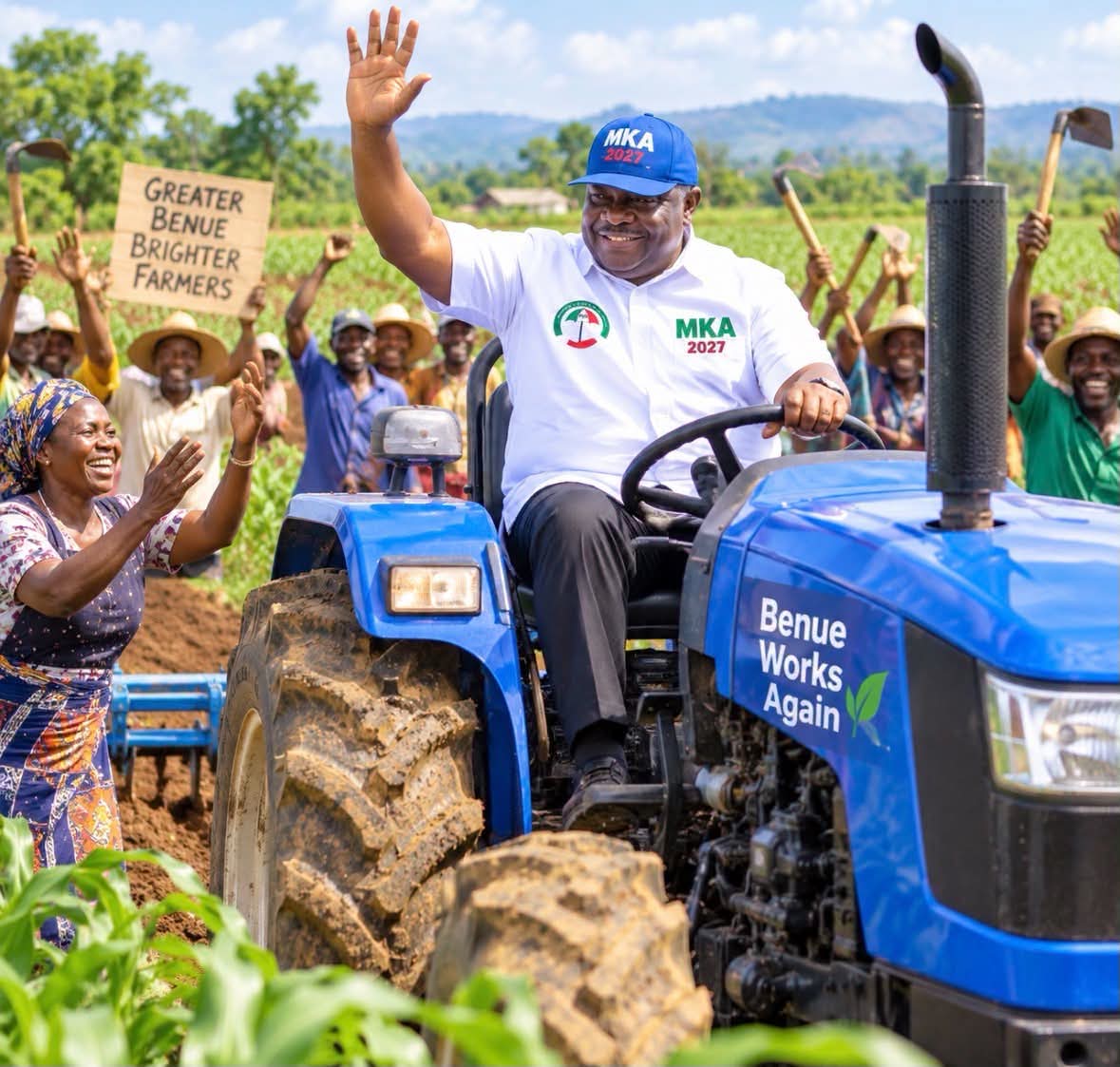
Since the Peoples Democratic Party (PDP) governorship candidate in Benue State, Chief Michael Kaase Aondoakaa, SAN, announced his intention to work with the private sector to create at least 100,000 jobs annually if elected governor in 2027, the declaration has understandably generated considerable public discussion.
Some have criticized the figure as too ambitious. Others have raised a legitimate question: Where will 100,000 jobs come from every year?
It is a question that deserves a clear answer.
First, Aondoakaa is not promising to recruit 100,000 people into the Benue State Civil Service every year. That would mean adding hundreds of thousands of workers to the government payroll over a four-year term, with enormous implications for recurrent expenditure.
That is not what the proposal is about.
The central idea is to make government an enabler of jobs rather than the employer of everybody.
The Aondoakaa proposition is that government should create the environment, infrastructure, incentives, financing mechanisms and partnerships that allow private businesses, farmers, cooperatives, entrepreneurs and investors to expand and employ more people.
This distinction is particularly important in Benue.
According to the National Bureau of Statistics labour-force data, about 93.4 per cent of employed people in Benue are self-employed, while only 6.6 per cent are classified as government employees. Agriculture accounts for about 84.6 per cent of employment. In other words, Benue’s economy is already overwhelmingly driven by people working outside conventional salaried employment in the public sector.
The challenge, therefore, is not simply to enlarge the government payroll. It is to make those productive private-sector activities larger, more profitable and capable of supporting many more livelihoods.
Think Beyond the Civil Service
When we hear the word “job,” we often imagine somebody receiving an appointment letter from a government ministry, department or agency.
But modern economies do not create most jobs that way.
A young person working in a cassava-processing factory has a job. A graduate employed by a logistics company has a job. A mechanic running a viable workshop and employing four apprentices has created jobs. A commercial farmer employing 20 permanent and seasonal workers is creating jobs. So is a software company employing programmers, an agro-processing plant employing technicians, a construction company recruiting artisans, or a cooperative financing members to build sustainable enterprises.
That is the broader economic ecosystem Aondoakaa’s 100,000-job target envisages.
Consider this simple illustration:
If government policies and incentives helped attract or expand 100 businesses that employed an average of 500 additional people, directly or indirectly each, that alone would represent 50,000 jobs.
The actual model need not involve 100 giant companies. It could involve thousands of enterprises of different sizes: some employing five people, others 20, 100, 500 or more.
Government can offer targeted incentives such as time-limited tax and levy relief, easier access to land, faster approvals and support for essential infrastructure, with such incentives tied to investment and job-creation commitments. The objective is simple: make Benue more attractive to investors, help existing businesses grow and translate private-sector expansion into sustainable jobs for Benue people. This is what Aondoakaa is offering.
The important point is that government does not have to put every worker on its payroll before it can influence job creation.
Benue has an especially significant opportunity in agriculture because employment does not end on the farm.
Take cassava, for example.
There are jobs in land preparation, planting, harvesting, aggregation, transportation, storage, processing, packaging, marketing and distribution.
The same principle applies to yam, rice, maize, soybean, sesame, citrus, livestock and other agricultural products.
Instead of measuring success merely by tonnes of crops harvested, the objective would be to retain more of the economic value of those products within Benue.
Why should agricultural produce leave Benue in its raw form when processing it locally can support additional businesses and employment? This is the alternative Aondoakaa is pledging.
That approach is not theoretical. Current agricultural development programmes in Nigeria are explicitly built around using private investment, agro-processing, aggregation, improved market access and agricultural value chains to generate jobs. The World Bank’s 2026 AGROW Programme, for example, is designed around precisely this relationship between agricultural value chains, private investment and employment.
What Has Aondoakaa Promised to Do?
I listened attentively to the PDP governorship candidate, and he said government’s role would be to make Benue attractive enough for businesses to invest, survive, expand and employ people.
That means addressing insecurity so that farmers and investors can operate; improving roads and other infrastructure; simplifying unnecessary bureaucratic obstacles; supporting access to finance; strengthening cooperatives; encouraging agro-processing; developing industrial and enterprise clusters; supporting skills acquisition; and deliberately attracting investors to the state.
It also means working with existing Benue businesses.
Sometimes, creating jobs does not require bringing a multinational company into the state. If a Benue entrepreneur currently employing 15 people can access financing, electricity, markets and a better business environment, and consequently expands to 50 employees, 35 additional jobs have been created.
Multiply such expansion across thousands of small and medium-sized enterprises, and the numbers begin to accumulate.
So, when Aondoakaa speaks of working with the private sector to create at least 100,000 jobs annually, the proposition should not be interpreted as handing out 100,000 civil-service appointment letters every year.
Rather, it is about creating the conditions that enable businesses, farms, cooperatives and enterprises to grow, invest and employ more Benue people on a sustainable basis.