

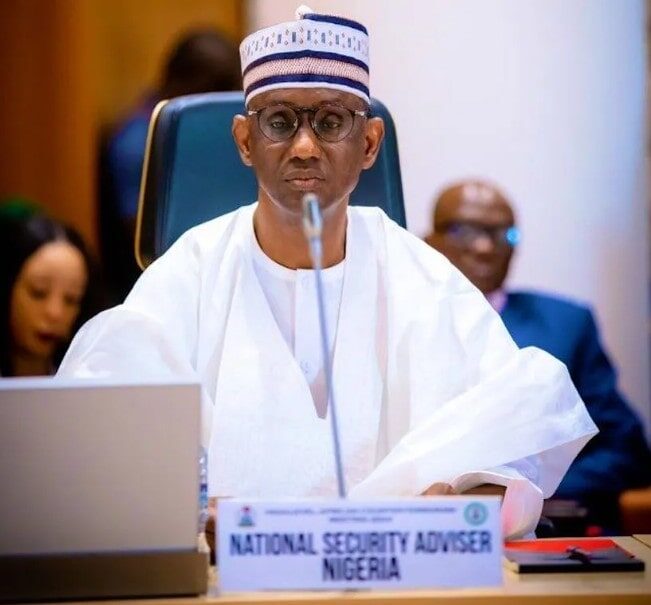
The National Security Adviser, Mallam Nuhu Ribadu, and the Chief of Defence Staff (CDS) stated yesterday that hunger and poverty are key drivers of insecurity, violence, and social breakdown across the country.
Their remarks came as President Bola Ahmed Tinubu, in Abuja, officially launched the deployment of 2,000 tractors under the Renewed Hope Agricultural Mechanisation Programme, marking the beginning of what he described as Nigeria’s agricultural renaissance aimed at boosting food production nationwide.
Both officials emphasized that hunger and poverty have now evolved into significant national security threats.
Speaking further, the NSA noted that the Tinubu administration is actively addressing these challenges through a multi-pronged approach, including prioritised agricultural reforms, expanded social investment programmes, and targeted security sector interventions designed to disrupt the cycle of poverty and instability.
Speaking at the 14th National Security Seminar organised by the Alumni Association of National Defence College in Abuja, Ribadu, who was represented by Major General PP Mala, Director, Defence Affairs, said: “This year’s theme, “Combating Hunger and Poverty for Sustainable Peace and Development in Nigeria,” touched at the very heart of our national challenges
“Hunger and poverty are not merely social concerns; they are catalysts for insecurity, crime, violence, and social disintegration. These issues form a vicious cycle. Poverty leads to insecurity and insecurity, in turn, deepens poverty.
“Under the leadership of President Bola Ahmed Tinubu, the Federal Government has prioritised agricultural reforms, social investment programmes, and security sector interventions aimed at breaking this cycle.
“These efforts are visible through increased support for food security initiatives, enhanced law enforcement capacity, and infrastructure to support agricultural production and distribution.
“At the Office of the National Security Adviser, ONSA, we continue to coordinate both kinetic and non-kinetic efforts across the armed forces, intelligence services, security agencies, and relevant government and non-governmental actors.
“Despite the progress made, issues like unemployment, hunger, and youth disenfranchisement remain persistent and require deeper, long-term solutions. This forum, therefore, presents an excellent platform for collective introspection and sharing of ideas. The challenges we face today are dynamic and multi-faceted. As such, our responses must be coordinated, inclusive, innovative, and forward-thinking.”
Chief of Defence Staff, General Christopher Musa, has asserted that hunger and poverty have transcended being just social issues and now pose serious national security threats.
Speaking through the Chief of Defence Training, Rear Admiral Ibrahim Shetimma, at a seminar, Gen. Musa called for a coordinated national strategy to tackle these challenges, warning of their escalating impact on Nigeria’s internal security.
He said: “Insecurity today is not only defined by weapons but also by economic deprivation, food insecurity, and social dislocation. Hunger and poverty are no longer mere social challenges, they have become national security threats.
“The North-Central region, particularly Benue State, once considered Nigeria’s food basket, is a clear example of how banditry, displacement and farmer-herder conflicts have devastated agricultural productivity.’’
General Musa highlighted that the disruption of farming communities and the illegal occupation of farmlands have significantly contributed to rising food inflation, widespread displacement, and mass migration—factors that threaten both economic stability and national unity.
He urged local communities to play an active role in countering insecurity by denying criminals and terrorists safe havens through intelligence sharing, prompt reporting, and heightened vigilance.
The Chief of Defence Staff also emphasized the urgent need for increased investment in grassroots agricultural development. He called on the government and stakeholders to elevate the status of farming by improving access to credit, infrastructure, and market opportunities, thereby making agriculture a respected and profitable profession.
“With the migration of rural youth to urban centres, agricultural productivity is declining. We must make farming attractive again — not as a last resort, but as a national duty and a prestigious calling,” he added.
Praising President Tinubu’s Renewed Hope Agenda, particularly its emphasis on financial autonomy for local governments, which he described as vital for responsive and community-driven development, Musa said: “I assure you, the Armed Forces of Nigeria, in synergy with other security agencies and with the support of the people, remain resolute in overcoming all security threats.
“We must build a Nigeria where every citizen can live in peace, engage in productive livelihood and enjoy the dividends of democracy.’’
In his remarks, the Defence Minister, Alhaji Mohammad Abubakar, called for human-centred security approaches to solving the challenges by addressing the root causes of insecurity, including unemployment, poverty and social exclusion.
Badaru said: “This seminar underscores the undeniable truth that lasting peace is impossible without addressing the socio-economic vulnerabilities that fuel discontent, radicalisation and crime.
“This year’s seminar, with its emphasis on critical human security concerns, particularly hunger, poverty, and violence, aligns closely with the President’s unwavering commitment to improving the quality of life for all Nigerians.
“This administration’s strategic interventions in agriculture, vocational training, and the provision of essential social services are already impacting countless lives and shaping a future defined by peace and human dignity.
“As we all know, the concept of national security has evolved significantly since the end of the Cold War. Today’s national and global realities demand a broader, human-centred security paradigm.
“It is increasingly evident that military solutions alone cannot fully address the complexities of today’s security challenges. We must confront the root causes — unemployment, poverty, hunger and social exclusion — through a coordinated, multi-sectoral and sustained approach.
“As clearly outlined in Chapter 2 of the National Defence Policy, the focus must now include economic, political, environmental, social and psychological well-being as central to our national security considerations.
The minister pointed out that in a world where security challenges knew no borders, there is need for collective action in addressing the nation’s security concerns.
While calling for a “whole-of-society” approach to tackle pressing issues such as hunger, poverty, and violence, he said: ‘’May our collective efforts continue to strengthen our path towards unity, resilience and sustainable national security.’’
Also speaking at the event, the President of AANDEC, Air Commodore Darlington Abdullahi, retd, underscored the need for sustained investment in education, economic empowerment and social inclusion as critical non-kinetic responses to Nigeria’s deepening food insecurity.
Abdullahi said hunger and poverty are not just humanitarian crises but also strategic threats to national stability, quoting the timeless wisdom that says “the children of the poor you fail to train will never let your children have peace.”
He stressed that neglecting the socio-economic well being of the population creates fertile ground for instability and extremism.
“When millions suffer from hunger and poverty, they become vulnerable to exploitation by those with ill-intentions. We must, therefore, invest in our people, especially in education, livelihoods and skills development.
“Economic initiatives that foster inclusion and bring communities together can be effective tools for peace-building, They create an atmosphere of stability and discourage violence,” he said.






Address: No 5 Ejembi Eko Street, New GRA, Makurdi, Benue State, Nigeria