
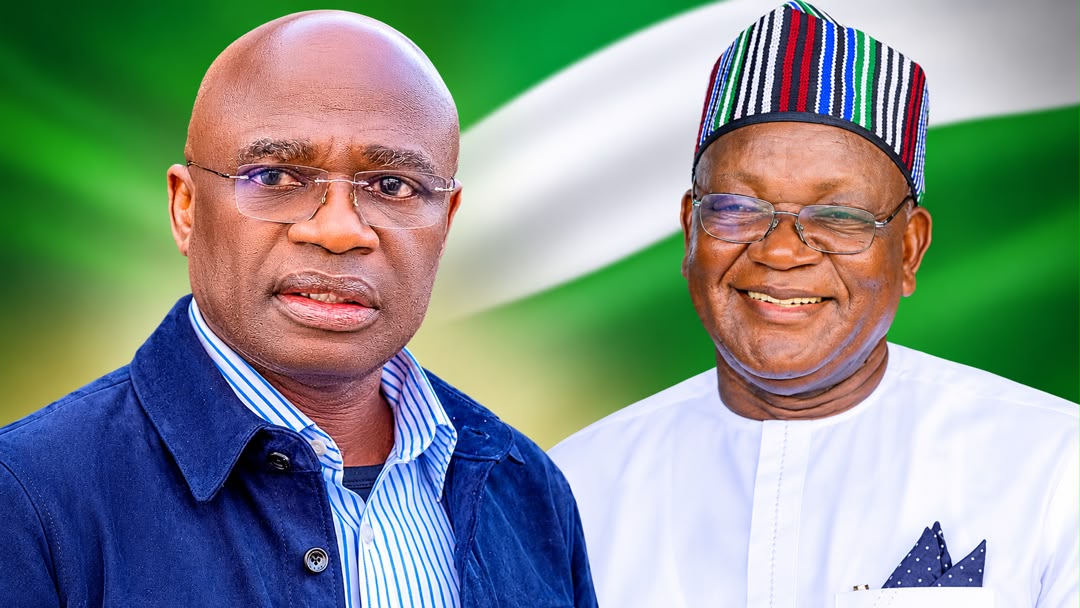
…Why Governors Like Ortom Struggled, and Why Alia Has No Excuse
Written Oliver Omenka.
One of the most revealing ways to assess the performance of Governor Hyacinth Alia is to compare the economic circumstances under which he is governing Benue State with those that confronted his predecessor, Chief Samuel Ortom, particularly during the administration of President Muhammadu Buhari.
The difference is enormous. And it raises a question that Governor Alia and his supporters would rather avoid: if Alia is struggling to meet the basic obligations of government despite the unprecedented increase in federal allocations following the removal of fuel subsidy, how would he have survived the severe financial crisis that confronted state governments during the Buhari years when Nigeria went into two recessions, followed by COVID-19 pandemic?
This is not a matter of political speculation. It is a question supported by public statements from two Nigerian presidents and the figures coming from the Federation Account.
On March 25, 2016, President Muhammadu Buhari made a startling admission at the second National Executive Committee meeting of the All Progressives Congress in Abuja. He disclosed that 27 of Nigeria’s 36 states were having difficulties paying the basic salaries of their workers.
Buhari attributed the situation largely to the collapse of international crude oil prices, Nigeria’s overdependence on oil revenue and the failure to prepare adequately for economic shocks. His statement was widely reported by several national newspapers. The Punch captured it under the headline, “27 States Have Difficulties Paying Salaries – Buhari.”
That was the economic environment in which governors, including Samuel Ortom, had to administer their states. Revenue was severely constrained, federal allocations were inadequate, and meeting recurrent obligations such as salaries, pensions and gratuities while executing projects at the same time became a major challenge across the country.
It is important to understand this context before passing judgment on the performance of any governor who served during the Buhari years.
Interestingly, President Bola Ahmed Tinubu has himself acknowledged the financial difficulties that confronted state governments before he assumed office. Speaking during a town hall meeting at Government House, Makurdi in June 2025, President Tinubu said he has given state governors so much money that they have no reason not to pay salaries and pensions or even think of borrowing before paying, unlike during the previous administration when 27 states were not able to pay salaries and pensions.
Similarly, in August 2026, while defending the removal of fuel subsidy, Tinubu recalled that 27 states were unable to pay workers’ salaries and that pensioners were also being owed. He described how governors had to approach the Federal Government for assistance because they could not meet their financial obligations.
Tinubu’s admission is particularly significant because it provides an explanation for the improved financial circumstances of state governments under his administration. Following the removal of fuel subsidy in May 2023, allocations from the Federation Account increased substantially, giving state governments considerably more resources than they had during the preceding years.
Indeed, the Minister of the Federal Capital Territory, Nyesom Wike, recently offered a revealing illustration of the difference in Benue’s financial fortunes. Speaking at an event in Abuja, Wike reportedly stated:
“A state like Benue which was receiving sometimes a meagre amount of N1.5 billion from Abuja now gets as much as N25 billion and even N30 billion every month.”
That is a remarkable difference. It is an indication of the financial windfall available to the current administration compared with what its predecessor had to contend with.
The figures are not merely political talking points. An analysis of FAAC disbursement records published by Nigeria’s revenue data trackers shows that between June 2023 and July 2026, Benue State Government and its 23 local governments received a combined net allocation of approximately ₦907.6 billion. This is a substantial inflow, even before accounting for subsequent allocations, internally generated revenue, grants and other interventions.
The contrast is therefore not difficult to establish: governors who governed during the Buhari-era revenue crisis operated under severe financial constraints, while their successors inherited a much larger revenue pool following the Tinubu administration’s fiscal reforms.
This is precisely why the performance of Samuel Ortom deserves a fair and historically informed assessment.
Despite the enormous financial difficulties his administration confronted over eight years, Ortom paid salaries for 91 out of the 96 months of his two terms in office. In other words, he fulfilled the salary obligations of his administration for all but five months out of eight years.
His record on pensions is equally significant. He inherited a pension liability of approximately ₦72 billion and, through payments made during his tenure, reduced that burden by about ₦42 billion.
Another significant achievement of Governor Ortom was placing the Benue State Judiciary and Benue State University on first-line charge for the payment of salaries and allowances. This ensured that, throughout his eight years in office, neither the university staff nor judiciary workers embarked on a strike over unpaid salaries and allowances.
These figures do not suggest that Ortom’s administration was without financial difficulties or that every worker and pensioner received all outstanding entitlements before he left office. Rather, they demonstrate the effort made by an administration operating under exceptionally difficult economic conditions to meet its obligations to workers and retirees.
Now consider the circumstances under which Hyacinth Alia assumed office in May 2023.
The economic reality facing Alia is almost the opposite of what confronted Ortom. President Tinubu removed fuel subsidy shortly after assuming office, and the resulting increase in revenue distributions to the three tiers of government significantly improved the financial capacity of state governments.
With this kind of financial advantage, what exactly has Governor Alia done with the resources available to his administration?
The answer is deeply disappointing.
Apart from the controversial, seemingly never-ending underpass project in Makurdi, which has become a recurring symbol of the administration’s obsession with one location, there is little evidence of commensurate development across the remaining local government areas.
Where are the major rural road projects? Where are the investments in healthcare, education, water supply, agriculture and industrial development? Where are the visible projects that should ordinarily accompany such a massive increase in public revenue
More disturbing is the continued difficulty the administration faces in meeting its obligations to workers and pensioners. Despite the substantial increase in allocations, salary and pension arrears remain a burden. This is an indictment of fiscal management, not a convincing explanation of financial incapacity.
It is particularly troubling that an administration enjoying a revenue environment that its predecessor could only have wished for is still struggling with obligations that should be among the first charges on government revenue.
And beyond the question of performance is the equally serious issue of accountability.
It is intellectually dishonest to ignore the economic crisis that confronted Ortom and other governors during the Buhari years while celebrating the increased allocations available to Alia under Tinubu. The same people who acknowledge that 27 states could not pay salaries under Buhari must also acknowledge that the removal of subsidy has substantially increased the resources available to states.
If Ortom could pay salaries for 91 out of 96 months and reduce an inherited pension liability of ₦72 billion by about ₦42 billion under those difficult circumstances, what excuse does Alia have for his present difficulties?
Indeed, if Governor Alia had governed Benue under the same revenue constraints that confronted Ortom during the Buhari years, his administration would most likely have collapsed under the weight of its own financial incompetence. He is finding it difficult to demonstrate responsible management even with the enormous increase in federal allocations.
The irony is that the present administration has more money but has yet to demonstrate a corresponding improvement in the quality of governance and the living conditions of ordinary Benue people.
Samuel Ortom governed when money was scarce and still made considerable efforts to meet the obligations of government. Hyacinth Alia is governing when money is more abundant, yet the results remain painfully unimpressive.
• Omenka, a public affairs analyst, writes from Abuja.